By Conrad Redmond, Painting Guides Editor. Updated September 2026
Hardboard siding can be repainted when most panels are still hard and flat and damage is limited to a few courses. Panels that are swollen, soft or crumbling along the bottom edge must be replaced first. When failure runs across most of a wall, re-siding that wall with fiber cement usually costs less over time than repeated repairs.
Why hardboard fails the way it does
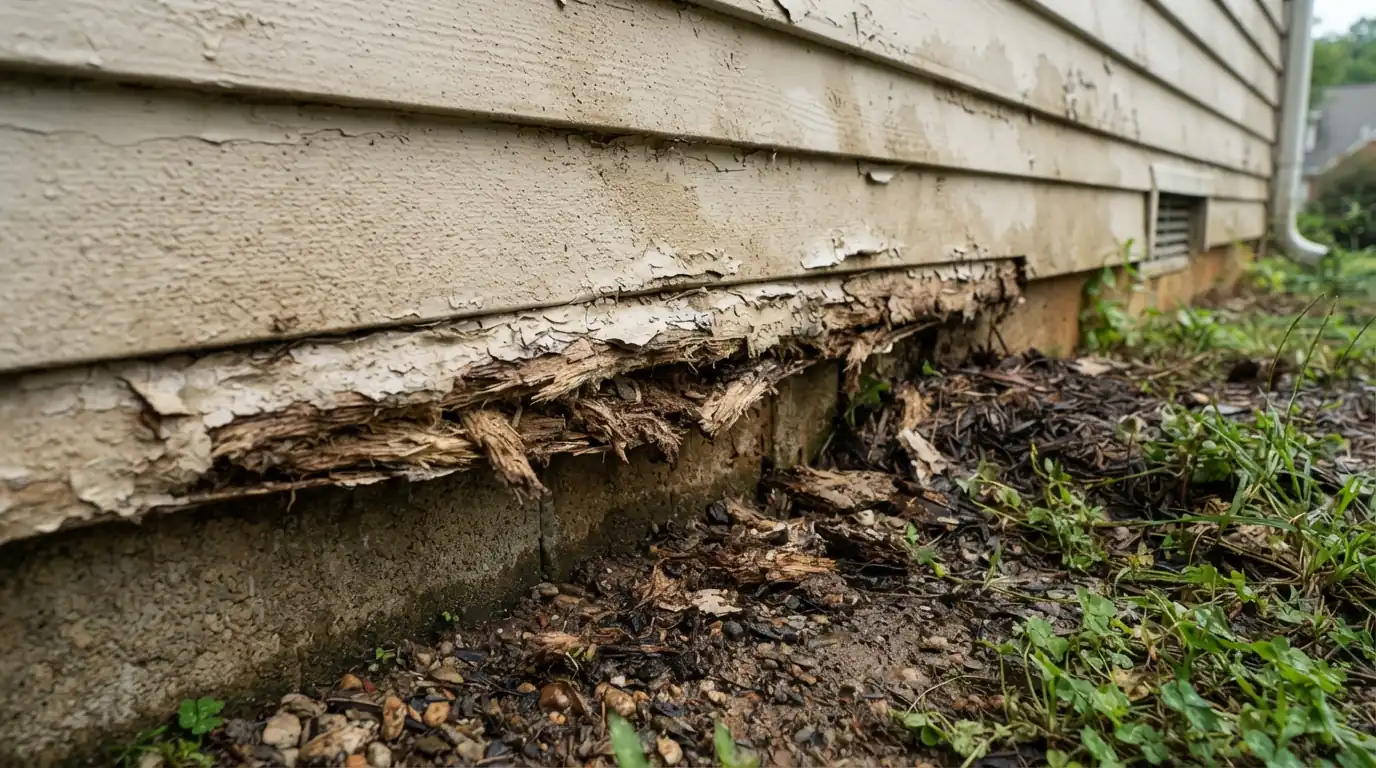
Hardboard is made from wood fibers pressed with resin and coated with a factory finish. It is stable and paints well as long as water stays out. Once water gets past the surface, through a hairline crack, an unsealed cut edge or a gap at a butt joint, the fibers swell from the inside and the panel starts to delaminate.
That is why failure starts at the bottom edges, around windows and at joints, and why it speeds up once it starts. A hairline crack becomes a swollen edge, and a swollen edge becomes a panel that crumbles when pressed.
The homes most likely to have it
Across Gwinnett and Walton counties, the subdivisions built through the 1990s and 2000s used builder-grade hardboard widely, and many of those homes are now 15 to 30 years old. Older master-planned communities such as Peachtree Corners, built from the late 1960s into the 1980s, used cedar shake, T1-11 and first-generation hardboard that is well past its service life.
On any of these houses, the south and west walls fail first because sun breaks down the paint faster there. Shaded north walls fail from the other direction, through mildew and moisture that never fully dries.
When repainting is the right call
If a probe finds the panels hard and flat, and the damage is limited to a few spots, repainting is a good choice. The prep matters: soft panels are replaced, every cut edge and butt joint is sealed, gaps at trim are caulked, weathered areas get a primer made for hardboard, and two coats of acrylic go on. Done that way, repainted hardboard can last a full paint cycle.
The mistake is painting over swollen panels. The new coat looks fine for a season, then the swelling continues underneath and the paint fails at the same spots. See siding and rot repair for how damaged panels are replaced.
Not sure what your siding needs? Call and we will probe every wall, count the bad panels and give you both options in writing.
Call (470) 741-8134When replacement makes more sense
Replacement starts to win when failure is spread across most of a wall, when the same panels have been repaired more than once, or when the house wrap behind the siding is damaged. At that point, repair costs keep coming back while the remaining original panels keep aging.
A common middle path is replacing only the worst walls, usually the sunny ones, with fiber cement and repainting the rest. Once painted, fiber cement and hardboard can look nearly the same from the street.
- Repaint: panels hard and flat, damage in a few courses.
- Repair and repaint: scattered soft panels, sound walls otherwise.
- Re-side a wall: swelling across most of one elevation.
- Re-side the house: widespread failure, damaged wrap, repeated repairs.
How repainted hardboard should be prepped
If the siding is sound enough to paint, the prep decides how long the paint lasts. The steps below are the ones that matter most on hardboard, and they are worth asking about on any quote.
- Replace every swollen or soft panel before painting, not after.
- Seal every cut edge and butt joint; bare hardboard edges soak up water fastest.
- Keep clearance above soil, mulch, patios and roof lines so the bottom edges can dry.
- Caulk gaps at windows, doors and trim with a paintable sealant.
- Prime weathered or chalky areas with a primer suited to hardboard.
- Apply two coats of a quality acrylic, sprayed and back-brushed into the laps.
What a probe tells you
The quickest way to decide is a probe along the bottom edges, around windows and at every joint on every wall. We mark soft spots, photograph them and count affected panels by elevation. That count usually makes the decision obvious.
Budget-wise, published Atlanta figures put pre-paint carpentry on neglected homes at around $2,000 to $5,000 or more. Our quotes list that carpentry separately from the paint, so you can see where the money goes. For overall numbers, see what exterior painting costs in Atlanta.
Questions readers ask
Hardboard often has an embossed wood-grain pattern and sounds solid but dull; swollen bottom edges are the giveaway.
No. Swelling means water is inside; the panel has to be replaced.
It is more resistant to moisture and holds paint longer, which is why it is the usual replacement.
Yes. Matching profiles can be used, and once painted the difference is hard to see.
A full paint cycle if soft panels are replaced and every edge and joint is sealed.